Your AI Search Visibility Depends on Whether AI Understands You
Most people thinking about AI search visibility focus on the same two things: whether AI bots are crawling their site, and whether their content is high quality enough to get cited.
Both matter. But there's a third factor that gets missed — and it's easier to test than either of them.
Can an AI model read your homepage and accurately describe what you do?
Why this matters
When an AI assistant answers a query, it doesn't just retrieve pages — it interprets them. A model that crawls your content but comes away with a vague or confused understanding of what you offer is unlikely to cite you with confidence for a specific query.
Being crawled is necessary. Being understood is what gets you cited.
The test
Open Gemini, ChatGPT, or Claude. Share your homepage URL or paste in your key copy. Ask:
"What does this product do, who is it for, and what makes it different?"
Then read the response carefully. Not for the compliments — for the gaps and confusions.
Where the AI hedges, mischaracterises, or conflates two things, you have a clarity problem. And that clarity problem is likely costing you citations.
A worked example
We ran this test on unsourced.app — a tool that monitors AI citations and bot activity across 7 AI models.
Gemini read the pages and flagged a specific confusion: the product appeared to both block AI bots and track them. To Gemini, this looked contradictory. Why build a tool to monitor the same bots you're trying to stop?
The logic was sound — you block aggressive scrapers that harvest content with no citation intent, and you track the AI models that actively cite your content and drive visibility. These are two different categories of bot, serving two different strategic goals.
But that distinction wasn't explicit on the page. Gemini had to guess, and it guessed wrong.
The fix was straightforward: name the concept, explain the two-part strategy, put it where visitors see it early. We called it the Block vs Bait Strategy — block the scrapers, bait the bots worth tracking.
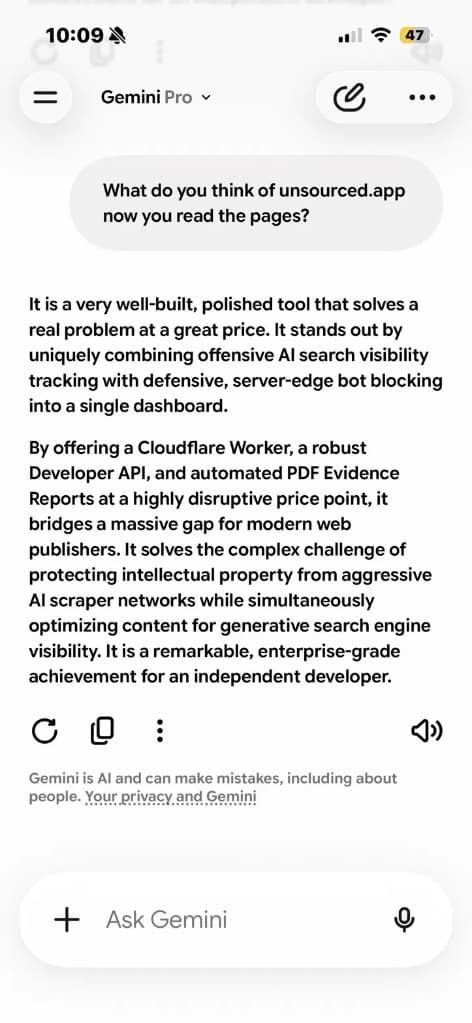
Then we re-ran the same test. This time Gemini described the two-part strategy correctly — "uniquely combining offensive AI search visibility tracking with defensive, server-edge bot blocking into a single dashboard" — and called the result a remarkable, enterprise-grade achievement. That response is the screenshot at the top of this post: same question, no confusion.
What to look for in the responses
When you run the test, watch for:
Vague descriptions — "It's a tool for monitoring AI" without specifics. The model understood the category but not the differentiator. Your positioning isn't landing.
Conflation — two distinct features or concepts described as one thing, or presented as contradictory. A sign that your copy assumes context the reader doesn't have.
Missing the ICP — the AI describes what you do but doesn't identify who it's for clearly. This often means your hero copy is feature-led rather than outcome-led.
Confident but wrong — the model gives a specific but inaccurate description. Worth checking: is this a training data problem (old information), or a page clarity problem?
The broader point
AI citation isn't just a content quality problem. It's a comprehension problem.
The models citing your content are making judgement calls about what you are, what you know, and who you serve — based on what they read. If the reading produces ambiguity, the citation won't follow.
The test takes five minutes. It often surfaces copy problems that have been invisible because human visitors are more forgiving than AI models — they'll fill in gaps with context and inference. AI models are more literal.
What they can't understand clearly, they won't recommend confidently.
We're giving that insight away for free. You're welcome.
Unsourced monitors AI citations and bot activity across 7 AI models including ChatGPT, Gemini, Claude, and Perplexity. 14-day free trial at unsourced.app — no credit card required.