Bing now shows AI citations. Here are 4 things it still won't tell you.
For a while now, the honest answer to "is AI recommending my site?" was a mystery. That changed this year. In February 2026, Microsoft launched AI Performance in Bing Webmaster Tools — the first time a major platform showed publishers when their content is cited in AI answers. In June, Microsoft expanded it with four new views: Intents, Topics, Citation Share, and Compare.
This is a genuine milestone. AI citation visibility is no longer a fringe idea SEOs argue about — it's a metric Microsoft now reports on. If you have a Bing Webmaster Tools account, turn it on. It's free, it's first-party, and it's worth watching.
But it's important to be clear-eyed about what these metrics are — and what they are not. Microsoft is refreshingly honest about this. Citation Share, they write, "does not expose competitor domains, represent traffic share, or assign quality scores to content"; it's "an observational metric – not a ranking system or a competitive scoreboard."
That honesty is the point. Bing's AI Performance is a thermometer — it tells you the temperature. It is not the diagnosis. Here are four things even the new metrics won't tell you, and why they matter.
1. Who got cited instead of you
Bing shows you your own citation counts, your grounding queries, and now your share of citations for a query. What it deliberately will not show you is the one thing you most want to know when you're not cited: who was?
Microsoft says it plainly — Citation Share "does not expose competitor domains." That's a reasonable privacy choice on their part. But when Copilot answers "best noise-cancelling headphones" with three sources and none of them are you, the names of those three sources are the whole game. They tell you who the model trusts on your topic, and what those pages do that yours doesn't.
Knowing your citation share dropped is a thermometer reading. Knowing which competitor's page replaced you is a plan.
2. What every other assistant is doing
Bing's data covers "Microsoft Copilot, Bing, and select partner AI experiences." That's a real and growing slice of AI search — but it is one vendor's slice.
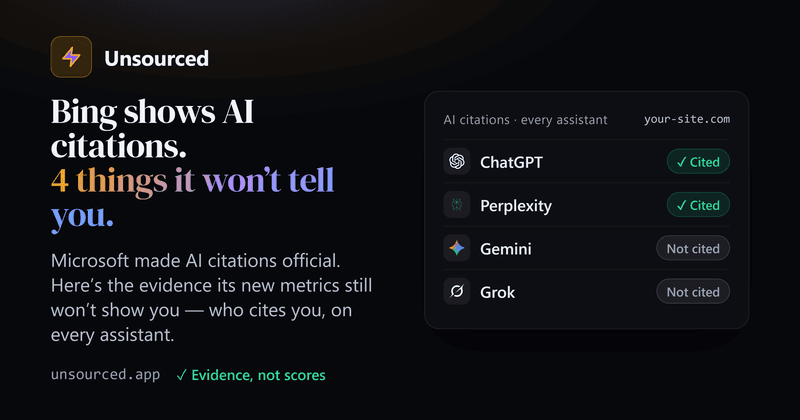
It doesn't tell you whether ChatGPT recommends you, whether Claude cites your documentation, whether Perplexity links you, whether Google's Gemini grounds its answer in your page, or whether Grok mentions your brand. Your customers are asking all of them. A publisher can be a citation darling in Copilot and completely invisible in ChatGPT — and Bing's dashboard will never hint at the gap.
Single-engine visibility is a real number. It just isn't the whole map.
3. The receipt — the actual words, and proof a crawler read your page
AI Performance reports that you were cited and the queries that triggered it. It does not hand you the receipt: the specific passage an assistant used, or independent proof that a verified AI crawler actually fetched your page around the time the answer was generated.
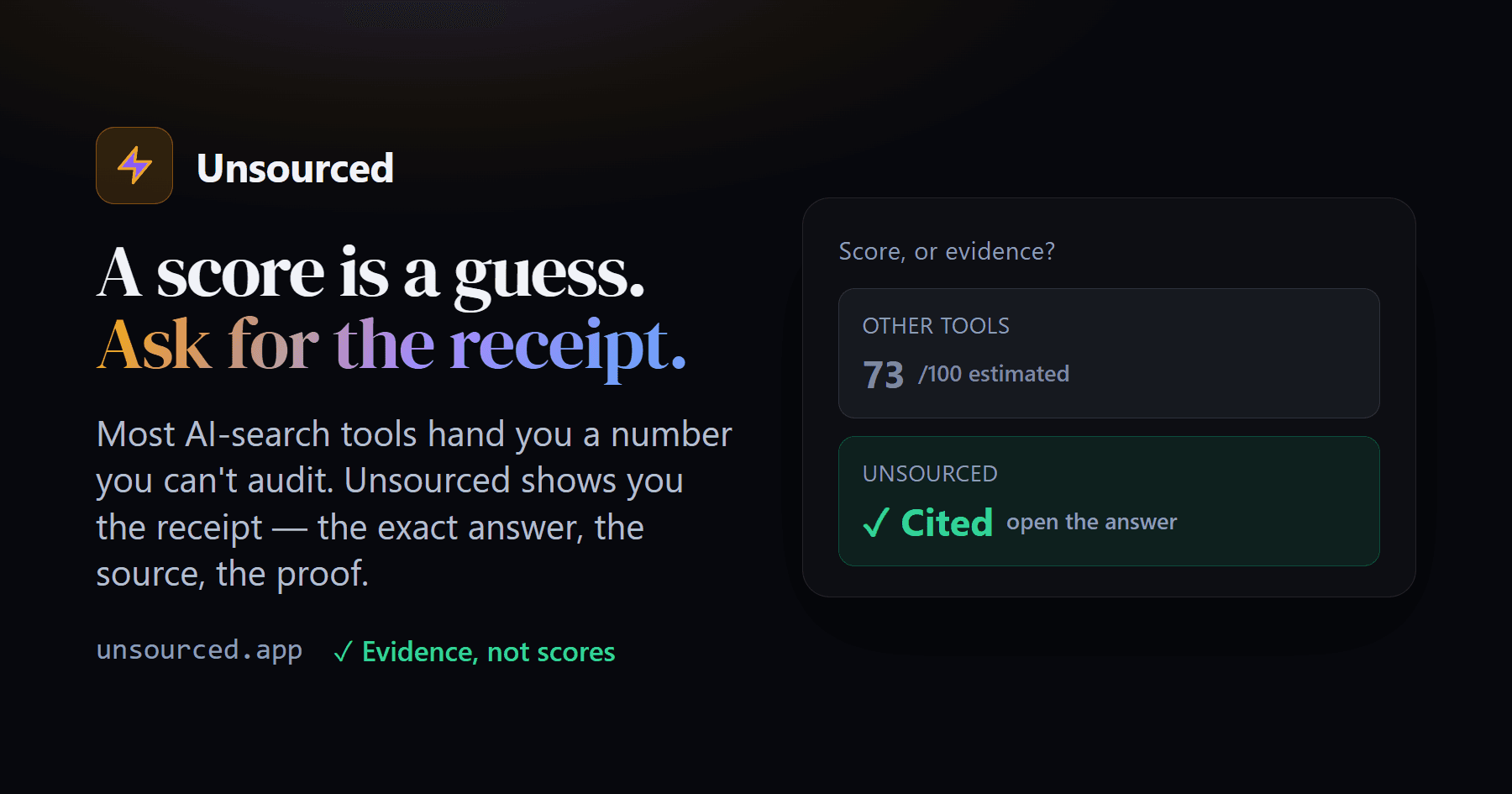
That distinction is the difference between a score and evidence. A count says "you appeared." A receipt says "here is the sentence the assistant lifted, and here is the log line showing OpenAI's crawler — confirmed by reverse-DNS and its published IP ranges, not a spoofer — reading that exact page during the scan window." One you can screenshot for a client or a licensing conversation. The other you have to take on faith.
4. The exact page to fix — tied to demand you already own
Intents and Topics are a great addition: they cluster your grounding queries into the subject areas driving citations, "in the same thematic structure that modern AI systems use." That helps you see the forest.
What it stops short of is the actionable, page-level version: "You already rank #4 in classic search for this query, you have real demand for it — and yet AI cites a competitor instead. Here's the specific URL to strengthen." That join — between the queries you already win in search and the ones AI overlooks — is where the fastest wins live, and it's not something a single-engine, observational report is built to give you.
The thermometer and the diagnosis
None of this is a knock on Bing. AI Performance is a good, honest tool, and Microsoft deserves credit for shipping it before anyone else did. Watch it. But treat it for what it is: a first-party signal that the temperature is changing, on one important set of surfaces.
When the temperature moves and you need to know why — who took your spot, on which assistant, using which passage, on which page you can actually fix — you need the layer underneath the number. That's the difference between a visibility score and an evidence layer. A score is a reading. Evidence is a receipt.
That's the layer Unsourced is built to be: we independently ask ChatGPT, Claude, Gemini, Perplexity, Grok and Copilot-class models the real questions your customers ask, capture who they cite, show the competitors who won when you didn't, and pair each result with the crawler-fetch evidence behind it — across every major assistant, not one.
Turn on Bing's AI Performance today. Then, when you want the diagnosis and not just the temperature, come see what the receipt looks like.
Further reading (primary sources):
Microsoft — Introducing AI Performance in Bing Webmaster Tools (Public Preview)
Microsoft — New AI Visibility Insights: Intents, Topics, Citation Share, Compare
Search Engine Land — Bing Webmaster Tools officially adds AI Performance report
Search Engine Journal — Bing Webmaster Tools Adds AI Citation Performance Data