
A score is a guess. Ask for the receipt.
AI visibility scores" are modelled guesses. Here's what evidence looks like instead — and why it's the only thing that holds up
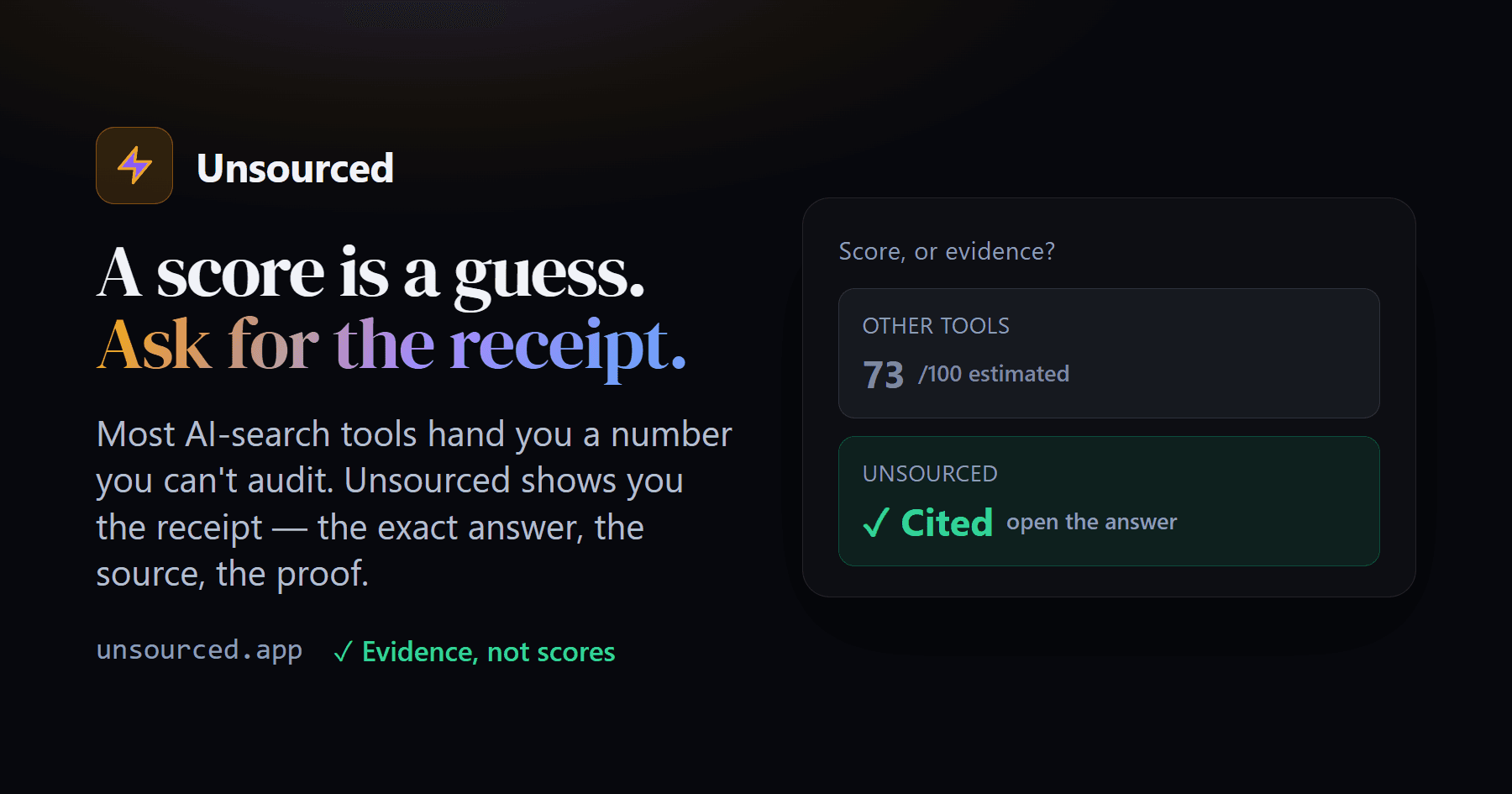
There's a new scramble on. Everyone wants to know if ChatGPT, Perplexity, Gemini and the rest are recommending them — and a wave of tools has appeared to sell you the answer. Most of them hand you a number. An "AI Visibility Score." A percentage. A grade out of 100.
Here's the uncomfortable question almost nobody asks: is that number measured, or modelled?
Because there's a world of difference, and it's the difference that decides whether you're making real decisions or decorating a dashboard. So before you trust any AI-search tool — ours included — here's how to tell which one you're holding.
Every tool is really answering two questions
Strip away the branding and there are only two things you can actually want to know:
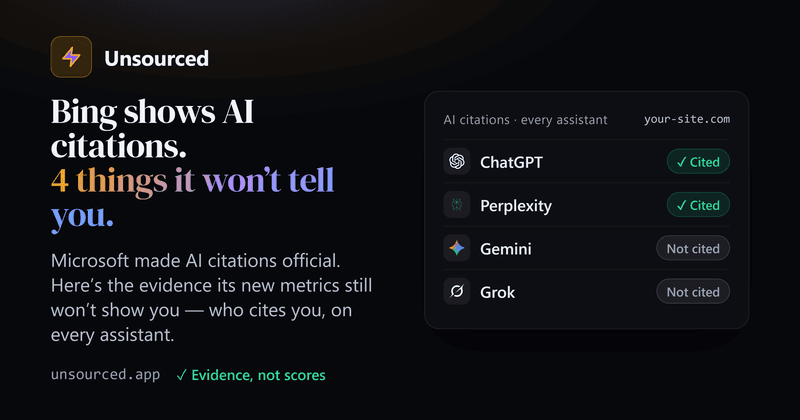
Are AI assistants citing me when people ask about my space?
Are AI crawlers actually fetching my site so they can cite me?
That's it. Everything else is presentation. The honest test is what a tool does with each one.
Question 1: citations. Everybody fires prompts. Not everybody keeps the receipt.
Let's be straight about how this works, because some marketing makes it sound like magic. To find out whether an assistant cites you, you ask it. You send prompts to the models and read the answers. We do exactly that. So does everyone else. Firing prompts is table stakes — it is not the moat, and anyone telling you their prompt list is a secret sauce is selling you the wrong thing.
The difference is what you're handed back.
A score collapses dozens of answers into one figure. You cannot audit a figure. You can't see which question triggered it, which model answered, what the answer actually said, or who got recommended instead of you. You're asked to trust the arithmetic.
Evidence keeps the receipt. For each check you should be able to see:
the exact question asked,
the exact model that answered,
cited or not — and the verbatim sentence if you were,
and which competitor showed up when you didn't.
One of these you can act on Monday morning. The other you can put on a slide.
Not every citation is worth the same — say so
Here's where most scoring quietly cheats: it treats a vague brand mention and a hard, sourced citation as the same point. They aren't.
There's a ladder of proof, and an honest tool grades where you actually landed:
A model mentioned your name (weak — models repeat names easily).
A model echoed your exact wording (stronger — that phrasing came from somewhere).
A verified crawler fetched your page during the scan window, and the model reproduced what was on it (strongest — that's the model reading you now, not reciting old training data).
A single blended number throws all of that away. We keep the rungs visible, and we'll tell you honestly when a citation is only a mention. A tool that won't grade its own confidence is asking you not to look too closely.
Question 2: crawlers. The ones that matter don't run JavaScript.
Now the inbound side — who's actually crawling you. This is where a lot of dashboards are quietly blind.
AI crawlers don't execute JavaScript. So if a tool is watching your traffic with a browser tag — the same way classic web analytics works — it cannot see the AI bots at all. They came, they fetched, they left, and nothing client-side ever noticed. You can't manage what you can't see.
Catching them means watching server-side, where the request actually lands. And catching them honestly means one more step: verifying identity. Anyone can set their User-Agent to GPTBot. Scrapers do it constantly to ride on a trusted name. The check is forward-confirmed reverse DNS against each operator's published IP ranges — does this request genuinely originate from the network it claims? A spoofed crawler should be flagged as an impostor, not counted as a visit from OpenAI. If a tool just reads the User-Agent string and believes it, its crawler numbers are inflated by every imposter on the internet.
The part nobody else closes: did your fix actually work?
This is the one that matters most, and it's the rarest. You read a report, you make a change, and then… what? Most tools hand you the next report and let you assume.
The honest version is a loop: you mark a gap as actioned, and roughly a week later the same question gets asked again so you can see, with evidence, whether the citation moved. Before and after. No promises, no "we got you ranked" — AI answers shift for a hundred reasons and anyone claiming clean causation is guessing. Just: here's what happened, measured.
The test you can run on any tool — including ours
You don't need to take anyone's word, mine included. Ask the tool to show you the receipt:
Can it show you the exact answer text where you were cited?
Can it show you the competitor that won the answer you didn't?
Can it tell you whether a real, verified crawler actually fetched your page — not just that something with the right name said it did?
Can it tell you whether your last fix moved anything?
If the answers are yes, it's measuring. If all it can offer is a number that went up or down, it's modelling — and a model of your visibility is a guess wearing a lab coat.
We built Unsourced because we were tired of scores we couldn't audit. The whole product is one stubborn idea: evidence, not scores. Prove it, don't grade it.
If you want to see what that looks like with real receipts instead of a number, the demo's open — no login: unsourced.app/demo