
Technical Briefing: The "Unlinked Share of Voice" — Forensic GEO as an Agency Retention Strategy
When rankings hold but the AI answers don't mention you, optimisation isn't the fix — an audit is.
An agency can show a client rankings that are holding steady and still get the same question every quarter: "So why aren't we in the AI answers?" Organic performance and AI visibility have come apart, and the standard report — rank tracking, traffic volume — has nothing to say about it. It can't see the thing actually happening: the referral pathway is eroding.
Agencies that answer with a vanity visibility score are . The way through is to stop reporting a number and start reporting evidence — to pivot to forensic Generative Engine Optimisation (GEO).
- Defining "Unlinked Share of Voice"
Traditional SEO measures Share of Voice through click-through rate. In the AI era that's incomplete. Unlinked Share of Voice (USoV) is the gap between an AI's ingestion of your content and its citation of it.
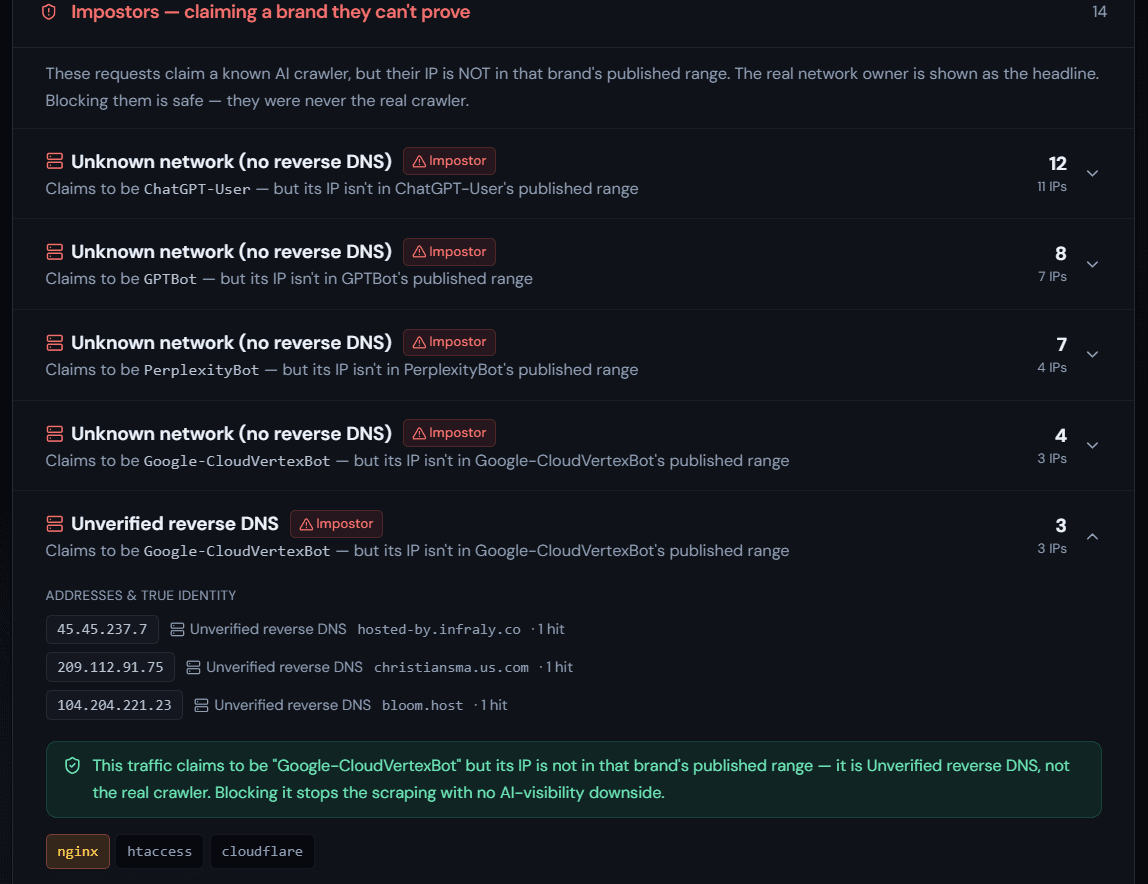
If an AI crawler — verified by forward-confirmed reverse DNS and published IP ranges — pulls your content, but the assistant's answer never cites the source, you've supplied the value and received none of the credit. That's asymmetric value extraction: the publisher provides the data, the model withholds the attribution.
- The Evidence Report: the forensic dossier
For an agency, the Evidence Report isn't a dashboard; it's a forensic dossier — and in a retention meeting it's the document that changes the conversation.
Show a client several thousand verified crawler requests against a 0% citation rate, and the question stops being "Are we ranking?" and becomes "Why is our intellectual property being ingested without attribution?" That single reframe moves the agency from a vendor delivering a service to an advisor delivering a technical audit.
- The agency pivot: from rank monitoring to forensic GEO
The shift is from monitoring rankings to running a structured, evidence-led protocol:
Phase 1 — The Baseline Audit. Use forensic crawl logs to establish the client's current USoV: which crawlers are accessing the site, and which specific topics — the gap — are failing to produce citations.
Phase 2 — Make the Page Quotable. The audit names the exact topics the client has demand for but isn't cited on. The agency works those pages specifically:
Put the answer where it can be lifted. Lead the section with the direct, self-contained answer to the question being lost — not three paragraphs of throat-clearing. An assistant quotes the sentence that stands on its own. Make claims traceable to the page. Specific figures, named methods, dated facts — the wording a model reproduces verbatim, and the same wording that later proves, on the inbound side, that the live page was used and not stale training data. Cut what no one's asking. The audit shows which queries fail; everything off that list only dilutes the page's relevance to the question that matters. None of this is assumed to work. Every change is a hypothesis — and Phase 3 is the test.
Phase 3 — Evidence-Based Iteration. This is where the agency earns the retainer. After the content work, it re-scans the exact topics that were failing and shows the client the before-and-after: did the assistants begin citing the page, or not? The movement is measured, sourced and dated — evidence of lift on that topic, not a claim of causation. Some changes will land and some won't; the point is that, for the first time, the client can see which.
- Why this cuts through the noise
Most AI-visibility tools report an inferred score — a single modelled number estimating how "visible" a brand is. Forensic GEO reports evidence insteadnsic GEO reports evidence instead. On the inbound side, every crawler's identity is confirmed by forward-confirmed reverse DNS and published IP ranges. On the outbound side, you get the verbatim line where an assistant cited the client — or the logged absence of one — graded by how strong the evidence is.
The agency working from evidence isn't selling a prettier dashboard. It's selling something a score can't: a record the client could put in front of a lawyer. That's the whole distance between "prove it" and "score it."
- The new retention anchor
The agency play aligns the client's interests with the agency's technical capability. By quantifying Unlinked Share of Voice, the agency sets a new benchmark for performance — one built on evidence rather than estimates. The client is no longer paying for rankings; they're paying for the forensic monitoring and evidence-led improvement of their standing in the AI ecosystem.
That's the transition from service provider to technical partner.
— Rene Roach, Unsourced