AI engines are starting to pay the publishers they cite. Can you prove you're one of them?
The economics of AI search are quietly flipping from "we took your content" to "we'll pay you if we cite you." That makes verifiable citation evidence a line item, not a vanity metric.
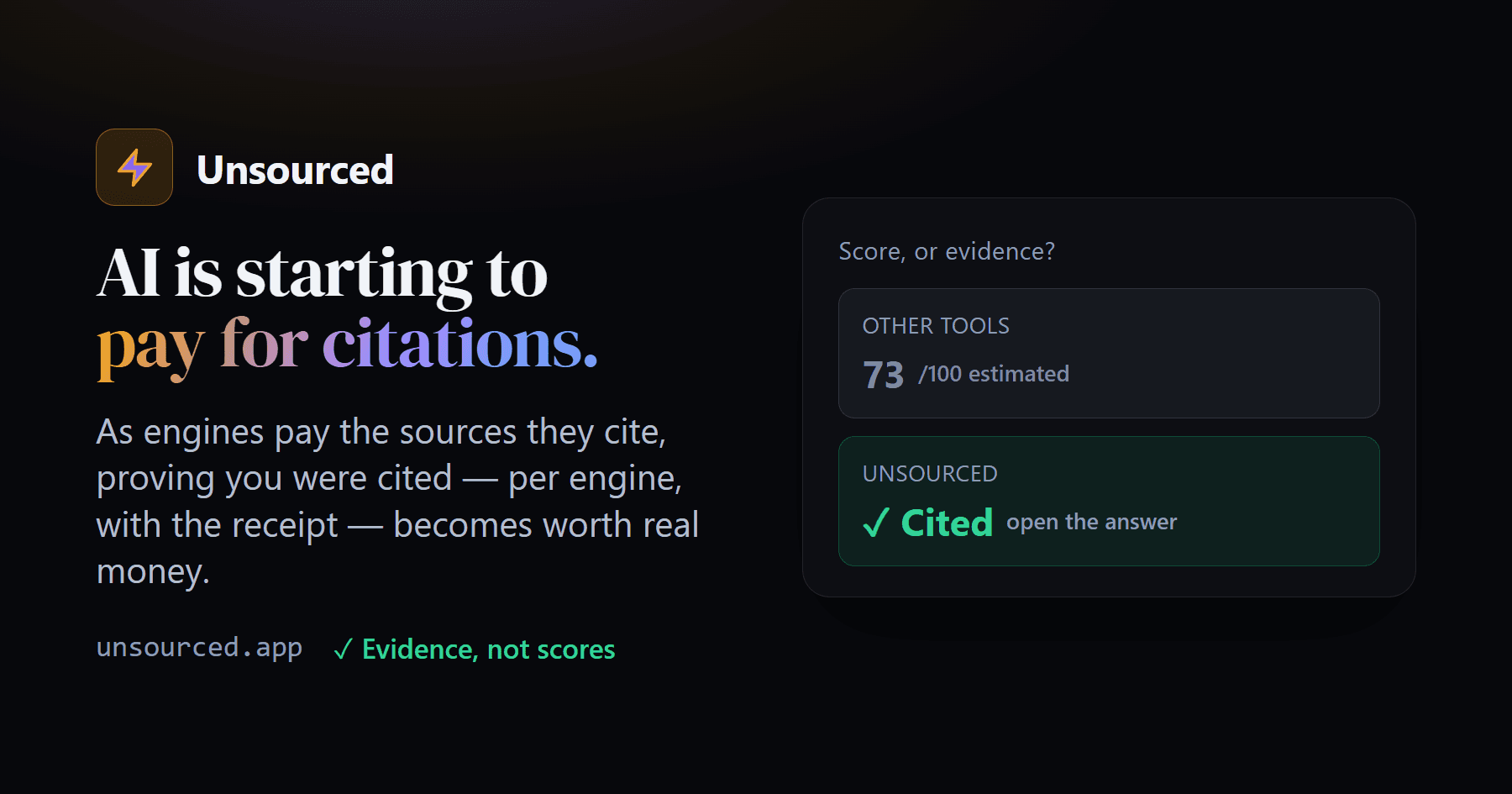
For two years the story of AI search has been extraction: assistants read your work, answer the question, and keep the click. That story is starting to change — and the change has a price tag attached.*
The last two years: traffic left, and it didn't come back
The numbers on zero-click search are no longer subtle. Google's zero-click rate climbed from 56% to 69% in the twelve months after AI Overviews launched — more than two-thirds of searches now end without a single outbound click. Over the same window, organic traffic to news publishers fell from over 2.3 billion monthly visits to under 1.7 billion — a loss north of 600 million visits a month.
If that were the whole story, it would just be a slow bleed. But something else moved in the other direction: ChatGPT referrals to news publishers grew roughly 25× year-over-year. The front door is being rebuilt. The traffic that survives increasingly arrives through an AI answer — and it converts far better than cold search (industry measurements put LLM-referred visitors at 15.9% conversion from ChatGPT versus 1.76% for organic search). Fewer visitors, but the ones who come are further down the funnel.
The new wrinkle: engines paying for what they cite
Here's the development worth paying attention to. Perplexity's Comet Plus programme reportedly sets aside a $42.5M pool for publishers, split 80/20 in the publishers' favour, allocated according to whose content gets cited in AI answers.
Set the exact figures aside for a second — the direction is what matters. It's the first serious attempt to align an AI engine's economics with the sources it leans on. For a decade, being "the source" was a cost you absorbed so you could win the click. In this model, being the cited source is the revenue event itself.
That reframes a question every publisher and marketer has been asking loosely — "are we visible in AI?" — into a much sharper one:
Can you prove, per engine, that your site was the cited source — with evidence someone else would accept?
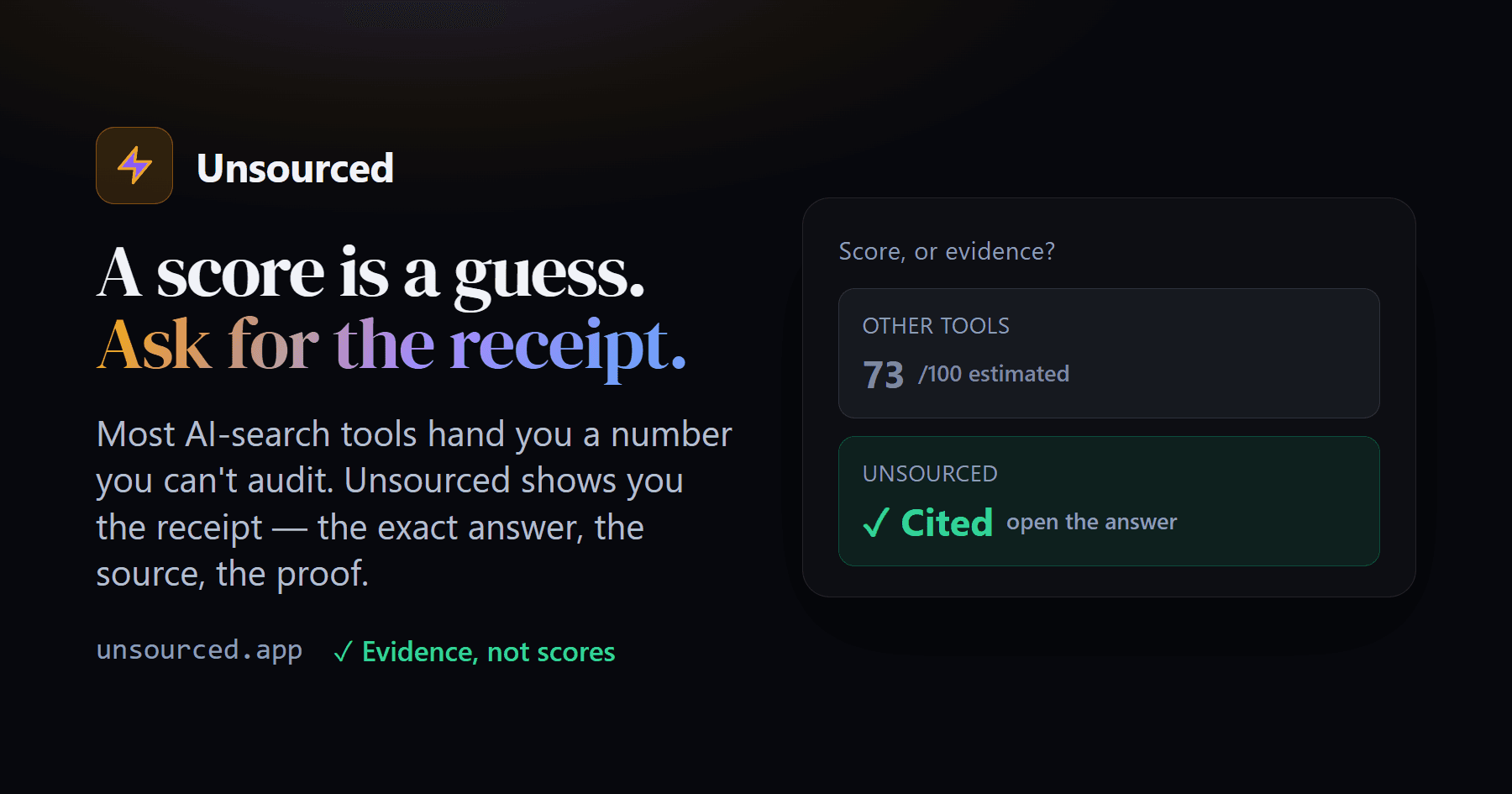
Because when there's money attached to a citation, "we think ChatGPT mentions us sometimes" is not an answer. A dashboard score out of 100 is not an answer. The receipt is the answer.
Why a "visibility score" won't survive contact with an invoice
Most AI-visibility tools hand you a single number and a trend line. That was tolerable while the stakes were reputational. It stops being tolerable the moment citations map to payouts, licensing conversations, or a rights claim — because a score is an estimate you can't audit, and the divergence between engines is enormous.
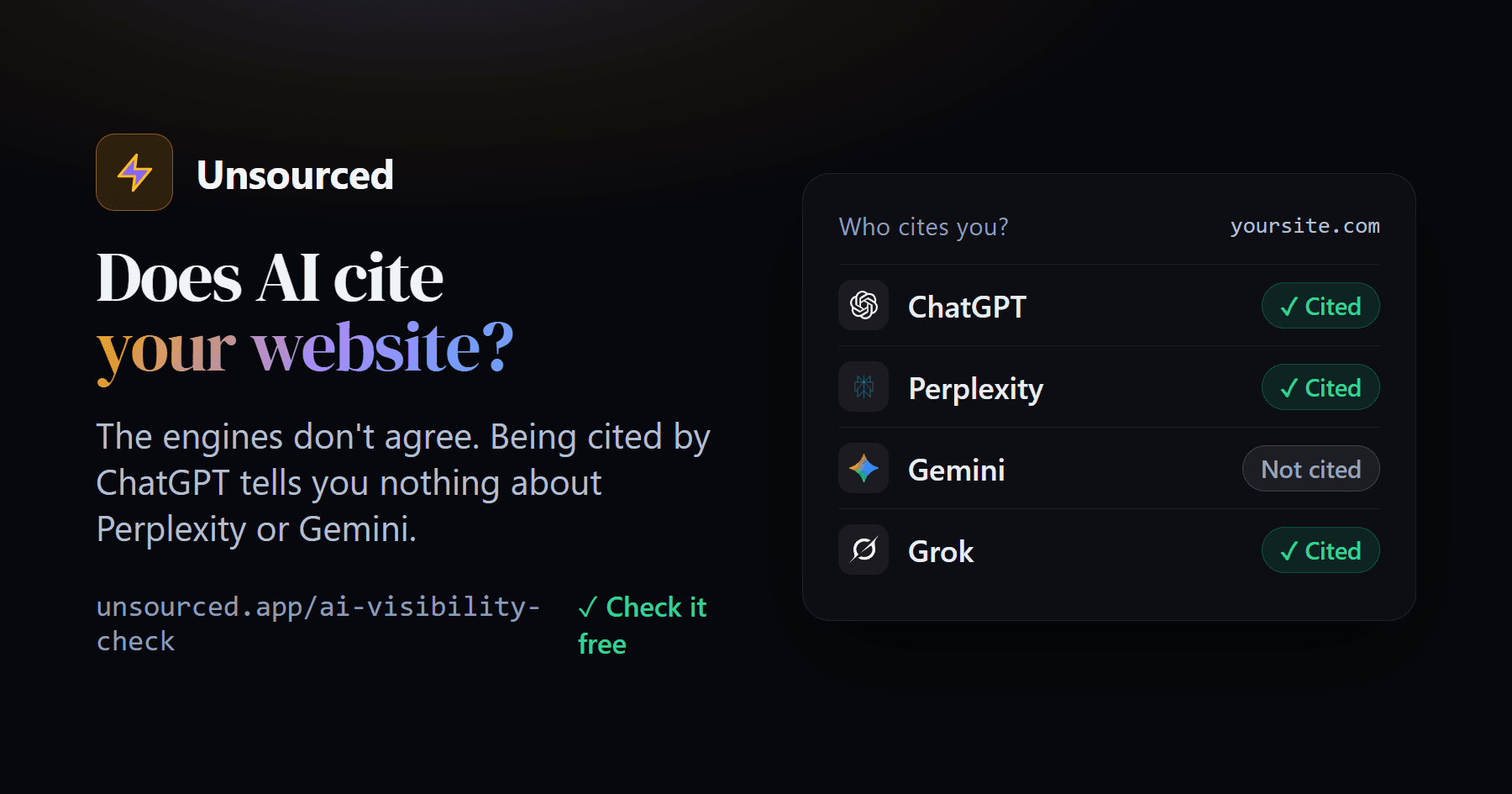
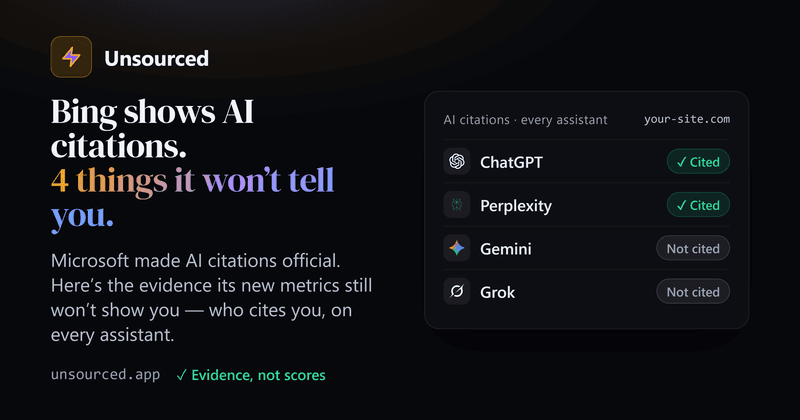
We know how large, because we measured it: ask seven leading assistants the same question and they agree on a source only about 16% of the time. There is no single "AI" to be visible in. Being cited by ChatGPT tells you almost nothing about whether Perplexity or Gemini cited you — and if Perplexity is the one writing cheques, Perplexity's citation record is the one that matters, specifically, with dates and the exact answer attached.
What "proof" actually looks like
This is the gap Unsourced was built for. Instead of scoring you, it captures the evidence:
The exact AI answer that cited you, per engine (ChatGPT, Perplexity, Claude, Gemini, Grok and more), with a timestamp.
The source list the engine showed — was it your URL, or a competitor's?
Whether the citation moved after you changed something — the same question, re-run, before and after.
Who's really crawling you. AI answers start with an AI crawler fetching your page. Unsourced verifies each crawler's identity against its operator's published IP ranges and forward-confirmed reverse DNS, so a spoofed "GPTBot" doesn't get counted as the real thing.
None of that is a number you have to take on faith. It's a record you can open, hand to a partner, or attach to a claim.
What to do this week
You don't need to wait for a cheque to act on this:
Find out where you actually stand. Run your domain through the free AI Visibility Check — it asks real questions to five AI models and shows you whether they name you or recommend other sites for your own topics. No login.
Watch the divergence, not a single score. Look at which engines cite you and which name rivals instead. That per-engine split is where the money — and the work — is.
Start keeping receipts now. The publishers who'll be ready when "cited = paid" becomes normal are the ones already holding dated, per-engine evidence, not the ones scrambling to reconstruct it later.
The extraction era rewarded whoever ranked. The era starting now rewards whoever can prove they were the source — cleanly, per engine, with the receipt in hand.
See how the evidence layer works on the live demo dashboard, or start a 10-day free trial — no card required.